



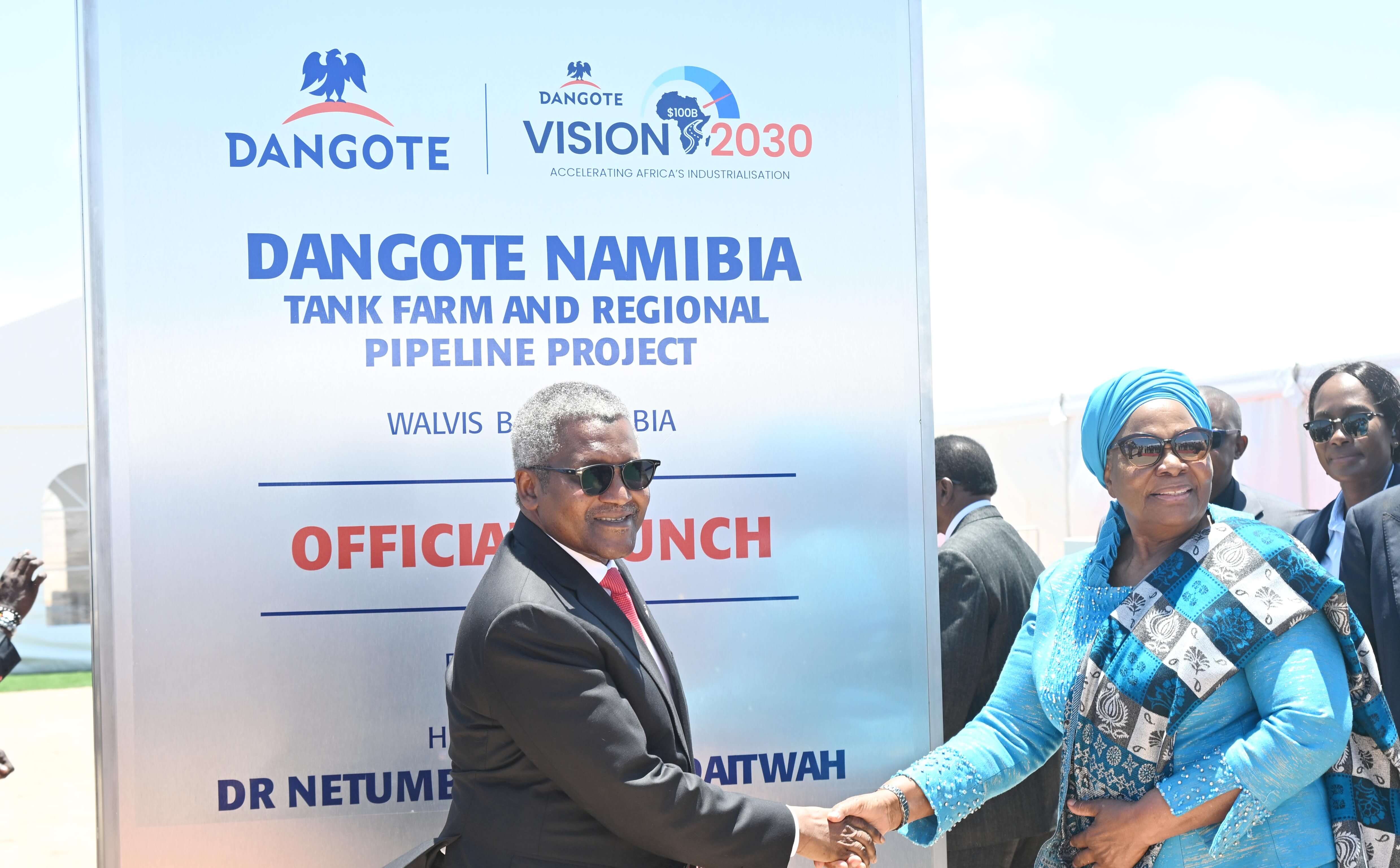
Aliko Dangote, Africa's richest man and oil mogul, has flagged off construction of the $2.5 billion Dangote Tank Farm and Regional Pipeline Project in Namibia, paving the way for his African integrated investment roadmap tagged Dangote Vision 2030.
The US$2.5 billion Dangote Namibia Tank Farm and Regional Pipeline Project, unveiled on Wednesday, November 4th, 2026, at Farm 58 in Walvis Bay by Namibian President Natusangwe Nambo-Kowatla and Dangote Group Chairman Aliko Dangote, has been an aspiration of the Namibian President since her inauguration on March 21, 2025, as the 5th President of an oil-rich nation.
According to Dangote, the regional infrastructure investment is economically critical and designed to transform Southern Africa's energy landscape, establishing the Port of Walvis Bay as a strategic Atlantic logistics hub. When operational, it will serve as a lifeline in getting these refined petroleum products to landlocked countries.
With AfrieximBank standing as the major funding partner, and according to the regional apex bank boss, Dr. George Elombi, also present at the flagged-off ceremony, the concept of the US$2.5 billion Dangote Tank Farm & Regional Pipeline Project in Namibia is built on trust and propelled by execution
The project's key infrastructure specifications, including component technical details and capacity as highlighted by Dangote in his keynote address, include 600 million litres (~4 million barrels) of storage capacity: 360 million litres of diesel and 240 million litres of petrol. This is eight times larger than Namibia’s current National Oil Storage Facility.
The regional pipeline network scope is expected to cover a 1,700-kilometre corridor, linking Namibia to Botswana, Zimbabwe, Zambia, Malawi, and the Democratic Republic of the Congo (DRC) inland through Otjiwarongo and Rundu; the Namibia internal distribution will be piped through a specialised 16-kilometre pipeline linking the coastal fuel jetty directly to the Farm 58 storage facility.
President Nandi-Ndaitwah noted that the project will remain a presidential project until completion, describing the Namibian objective as developing an integrated petroleum infrastructure project that strengthens Namibia's position as a regional energy and logistics hub, while reducing avoidable costs and creating local employment for Namibians, followed by other African professionals, and opening high-value supply chain opportunities for local companies.